
Specimen of the Month


June 2026 - Magnetotactic Bacteria - The microbes with internal compasses
Some organisms are impressive because they run fast, fly high, or survive terrible conditions. Magnetotactic bacteria are impressive because they build compasses inside their own cells.
These bacteria produce tiny magnetic structures called magnetosomes: membrane-bound crystals of magnetic iron minerals, usually magnetite or greigite. In many magnetotactic bacteria, the magnetosomes are arranged in chains, turning the cell into something like a living compass needle. The cell is propelled with flagella like many motile bacteria, but the magnetosome chain helps align that cell movement with Earth’s magnetic field.
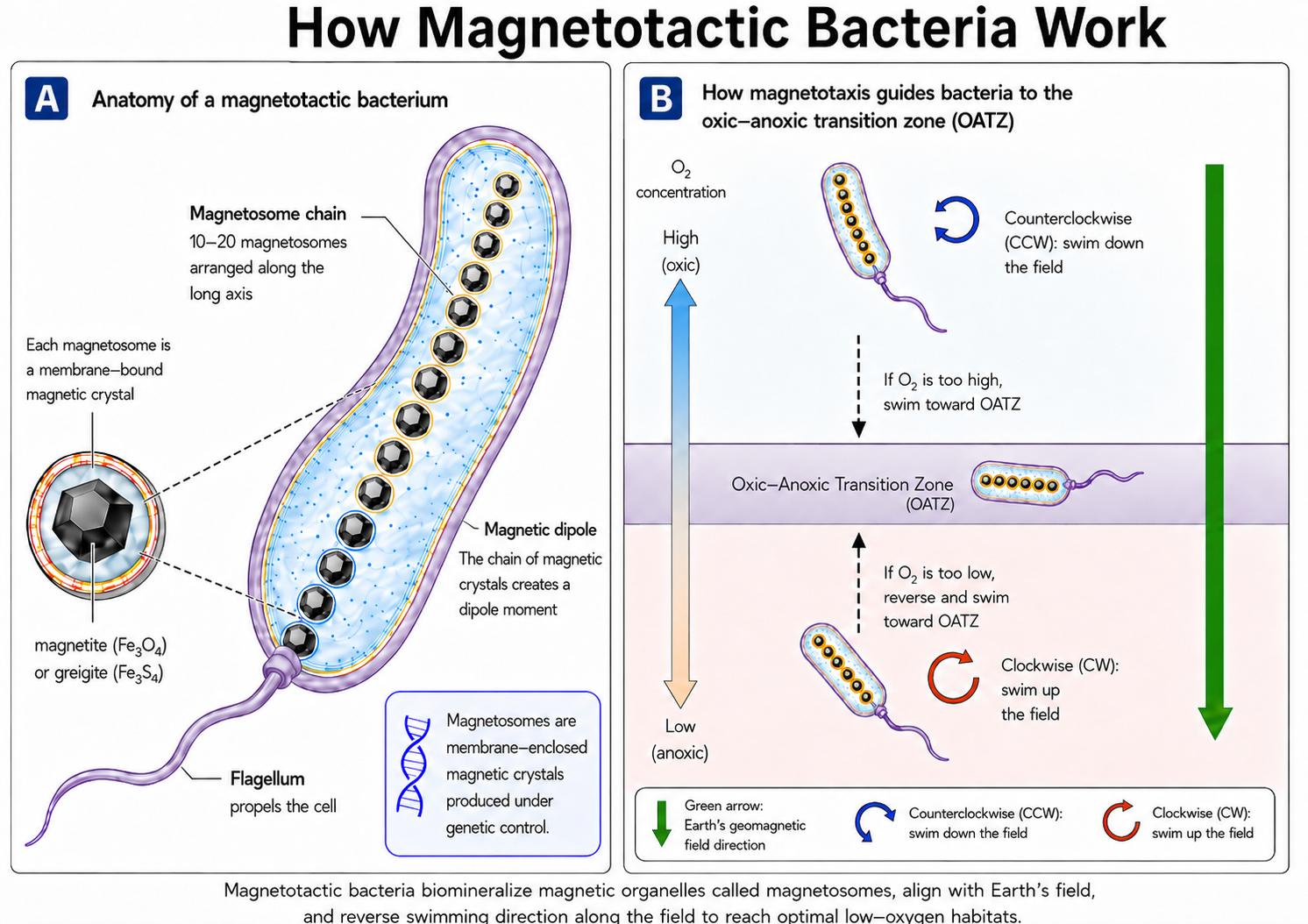
That sounds like a bacterial party trick, but it solves an interesting problem. Magnetotactic bacteria often live in chemically layered water or sediment, especially near zones where oxygen drops and reduced compounds increase. In that kind of habitat, the “right” place to live may be a narrow band above or below the cell. Magnetism helps simplify the search. Instead of wandering randomly in three dimensions, the bacterium can align along magnetic field lines and swim more efficiently through the gradient.
The most remarkable part is how controlled the whole system is. Their formation involves membrane remodeling, specific proteins, iron transport, mineral crystallization, and careful chain assembly. These magnetosome chains are among the most complex structures known in prokaryotic cells, with key functions encoded by roughly 30 genes clustered in a genomic “magnetosome island.”