
When Fabric Becomes a Health Claim
The strange, plausible, overmarketed science of far-infrared clothing.


The strange, plausible, overmarketed science of far-infrared clothing
I had never seen anything like this.
I found a shirt. I didn't find it through an ad served to me by an algorithm, or a wellness influencer promising “cellular optimization,” or a sleek recovery brand charging ninety dollars for compression leggings. It was just a soft-looking “Cuddl Duds” sleep shirt on a clearance rack. I was looking for a new set of pajamas, saw the name on the tag had a word resembling “cuddle”, felt that it was soft, in my price point, and a color I liked. Mission accomplished! I’ll sleep like a baby tonight! Then I noticed something else on the tag… “Far-Infrared Enhanced Sleepwear” or something of the sort.
My first reaction was something like: That sounds insane. Here’s another wellness gimmick in the works.
My second reaction was: Wait, what on Earth could they possibly even be claiming here?
That is usually where science gets interesting. The most tempting response to a product like this is to dismiss it immediately. Clothing that emits “far-infrared energy” sounds like the kind of thing that belongs somewhere between copper bracelets and detox foot pads. But skepticism is not the same thing as incuriosity. A good scientist should be able to be suspicious and intrigued at the same time.
I bought the shirt.
I did not buy it because I expected it to alter my physiology. I bought it because it was on clearance, extremely soft, and seemed like a perfectly good sleep shirt. That may not be the dramatic consumer conversion story their marketing team imagined, but it did get me out of the store with a shirt.
After I brought it home, I started looking into the broader world of far-infrared clothing: recovery garments, compression leggings, therapy sleeves, shapewear, socks, and sleepwear that claim to improve circulation, reduce soreness, support healing, relieve pain, enhance recovery, or improve sleep.
The deeper I looked, the more interesting the question became. Far-infrared clothing is not obviously fake in the way that some wellness products are fake. The underlying physics is real. Fabrics can be engineered to absorb and emit radiation differently. Mineral powders, ceramic particles, fiber shape, and textile structure can change the far-infrared behavior of a material. But like many wellness trends, I learned that the marketing of these enhanced clothing items often moves faster than the evidence behind their efficacy.
A claim that a fabric emits far-infrared radiation is not the same as a claim that a shirt improves your sleep, relieves pain, reduces inflammation, or speeds muscle recovery.
That distinction is the whole story.
The Claims
Far-infrared garments are usually marketed around a simple idea: the fabric contains ceramic, minerals, or other particles that absorb body heat and re-emit energy back toward the body in the far-infrared range. Some companies describe this as “reflecting” the body’s own energy; others describe it as a kind of passive, wearable therapy. Cuddl Duds, for example, says its men’s far-infrared sleep top has infused ceramic fibers that “help to enhance circulation for recovery and encourage restful sleep,” and sells the shirt for $30 on its own site. Macy’s lists a short-sleeve version with similar sleep language at a sale price of $20.25, down from $30. Kohl’s had it for $14.99.
Other sellers go much further. Therapy Garments says its Bioflect garments “harness the energy of your own body to promote self healing” and lists claimed benefits including enhanced circulation, lymphatic drainage, increased skin elasticity, cellulite reduction, pain reduction, and reduced lactic acid buildup after sport. There is even language about their products being "life changing". FarInfraredFashion.com claims that far-infrared clothing improves circulation, relieves pain and swelling, supports healing, helps with fibromyalgia, weight loss, cellulite, and other ailments. One men’s infrared compression T-shirt is listed at $97.95, while some leggings and shapewear run roughly $80–$100. As of the time of this publication, two pairs of socks are listed as being sold for $99.95 (on sale from $133.95). If this FIR technology is going to enable a clothing company to sell socks for almost $100, you’d think this would be life changing right?
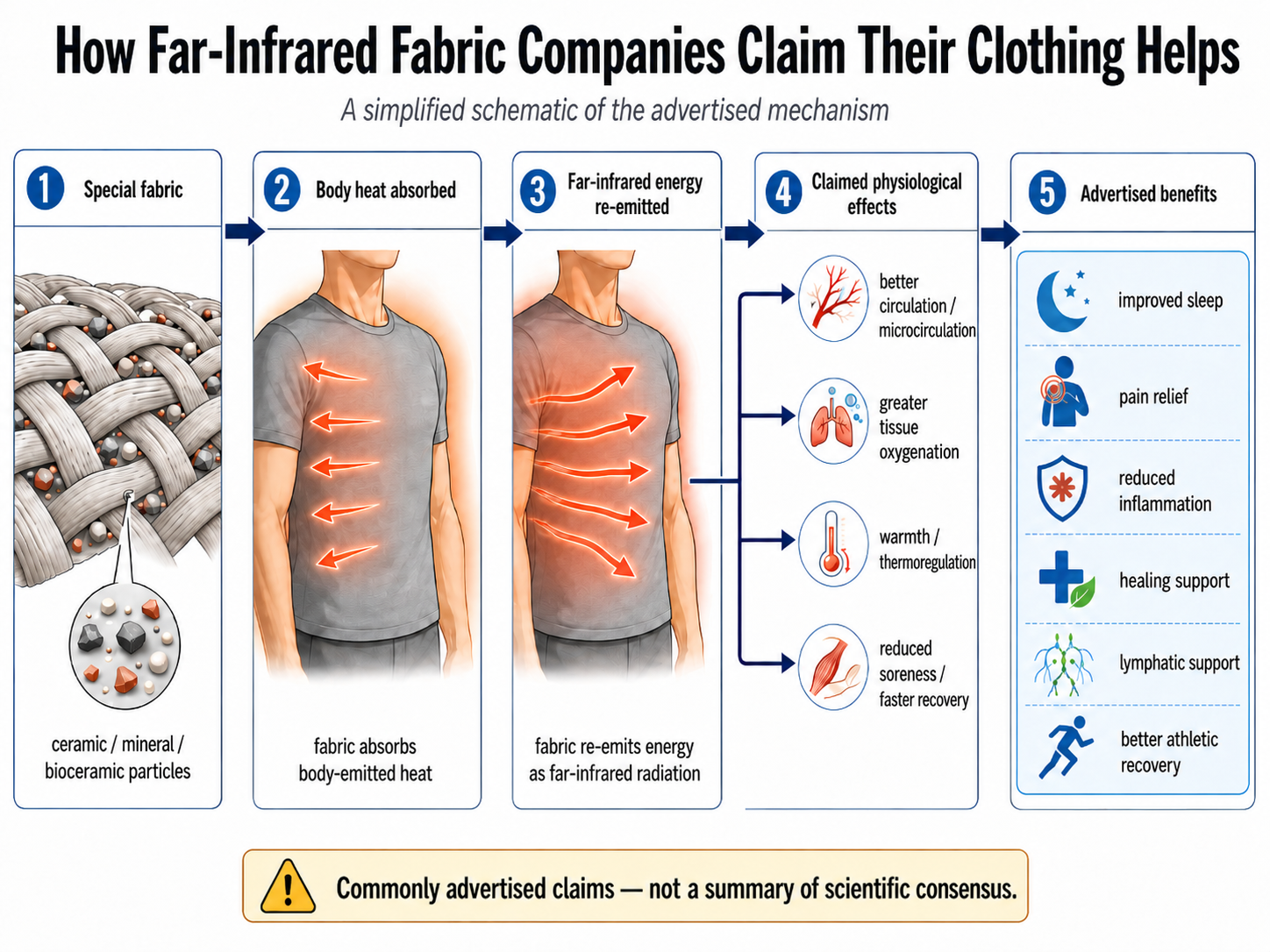
This is where the scientific question becomes interesting. The question is not, “Can textiles be engineered to emit far-infrared radiation?” They can. The better question is, “Do these garments produce meaningful, reliable physiological benefits in real people?”
The Materials Science
The materials science is probably the strongest part of the story for garment companies. In one textile study, researchers compared triangular and circular polyamide fibers and found that the triangular fiber fabric had higher far-infrared emissivity, 91.85% versus 86.72%, and a higher measured temperature difference, 2.11°C versus 1.52°C. This isn’t a health study. The argument was that fiber shape changes optical paths, absorption, and emission. That does not prove a health benefit, but this study is interesting because it does show that fabric architecture can measurably alter far-infrared properties.
Another materials study in Scientific Reports incorporated natural mineral powders into polypropylene films. Adding 2% mineral powder increased far-infrared emissivity in the 5–14 µm range by about 7.65–14.48%, and some mineral films also showed strong UV protection and near-infrared shielding. Again, this is real materials science. It is also not a human recovery trial.
So, the next question is not whether the fabric can do something interesting in a lab test. The next question is whether wearing it changes anything meaningful in a human body.
The Biology
The best review I found on far-infrared garments in sports is a 2021 systematic review in PLOS ONE that was subtitled, appropriately, “Real potential or new fad?” The authors searched five databases and included only studies testing far-infrared-emitting garments in humans for exercise performance or recovery. They excluded far-infrared saunas and powered devices because those have greater irradiance or power density than passive garments. They also excluded textile-engineering studies that were not sport or exercise studies. In other words, they asked the right question: what do the garments themselves do?
The answer was cautious. The review found only eleven studies: six testing garments during exercise and five testing garments during post-exercise recovery. The authors concluded that the studies were scarce, heterogeneous, and inconclusive, preventing firm conclusions about the use of far-infrared garments in athletes. They did say the garments may be of interest, mainly through effects on thermoregulation and hemodynamic function.
That is the measured middle ground. Not “fake.” Not “proven.” Interesting, but early.
The recovery evidence is especially important because “recovery” is one of the claims consumers are most likely to encounter. But recovery is not one thing. It can mean less soreness, better sleep, faster restoration of strength, lower creatine kinase, reduced inflammation, improved range of motion, better sprint performance, or simply feeling better the next day. Those outcomes do not necessarily move together.
The PLOS ONE review found mixed results. Across the post-exercise studies, far-infrared garments did not significantly improve recovery of muscle function, including isometric and dynamic muscle strength or sprint performance. But some studies showed small-to-large effect sizes for indirect markers such as delayed-onset muscle soreness, oxidative stress, inflammation, and range of motion. Blood creatine kinase, a common indirect marker of muscle damage, was not consistently improved.
Put more plainly: if recovery means “I subjectively feel a little less sore,” the evidence is more suggestive. If recovery means “my muscles objectively regain strength faster,” the evidence is much weaker.
One good example of the work that was evaluated in that review was a study published in the Journal of Human Kinetics. It is useful because it tested far-infrared garments in almost exactly the situation where recovery clothing ought to have a chance to prove itself: after muscle-damaging exercise.
In that study, moderately active men performed an exercise designed to produce soreness and temporary loss of muscle function. Participants then wore far-infrared-emitting ceramic pants during the recovery period. If these garments reliably speed recovery, this is the kind of experiment where you would expect the signal to show up.
But the results were underwhelming. The far-infrared pants did not significantly improve maximal voluntary contraction, creatine kinase, lactate dehydrogenase, delayed-onset muscle soreness, or even perceived recovery status. In other words, when recovery was measured several different ways the far-infrared garment did not clearly outperform the placebo garment. The broader review summarizes the post-exercise evidence in the same direction: no significant benefits for muscle-function recovery across studies, with only more suggestive effects for some indirect markers like soreness, oxidative stress, inflammation, and range of motion.
That negative result should carry real weight. It does not prove far-infrared garments never do anything, but it does show why the evidence should not be described simply as “small but promising.” It is small, mixed, and sometimes negative even in precisely the settings where the products are supposed to help.
That is a major problem for the marketing claims.
Other studies also reflect the uncertainty of the effects of these garments. A 2022 study in Lasers in Medical Science tested far-infrared-emitting pants in fourteen resistance-trained men using a randomized, double-blind, placebo-controlled crossover design. The design was stronger than many wellness studies I came across on this topic but not a great sample size overall. Participants wore the FIR pants for about 82 hours before testing. The researchers reported significantly higher pre- and post-fatigue maximal voluntary contraction values in the far-infrared condition, and a near-significant trend (p=.055) for total work, but no changes in thigh temperature or EMG signals.
A newer 2025 study gives the more optimistic side of the literature. In that study, ten recreationally active adults completed a resistance-exercise protocol and were assigned to wear either far-infrared-emitting tights or placebo tights during recovery. The FIR group showed greater recovery in several countermovement-jump measures, including jump height, takeoff velocity, and modified reactive strength index, especially by 48 hours. That is interesting and worth following. But the study was extremely small — only five people per group — and fatigue biomarkers did not differ between groups. So the result is better understood as a promising pilot signal than as strong evidence that FIR clothing reliably improves recovery.
This 2023 study tested a whole-body FIR suit in ten recreational trail runners during a short treadmill protocol. The design was reasonably careful (double-blind, randomized, placebo-controlled, and crossover) but the outcome was indirect. The FIR suit altered bioelectrical impedance measures, which the authors interpreted as possibly related to fluid distribution, superficial circulation, and heat management. That is interesting, but it is not the same as showing better recovery, improved sleep, less soreness, or superior performance. The authors also rightly state that "further studies with larger samples and greater detail will be necessary to clarify the efficacy associated with the use of FIR fabrics, investigating all aspects of this technology, and defining potential applications".
These more recent studies provide interesting signals, but they are also a small with narrow outcomes. They do not prove broad recovery benefits. They do not establish a mechanism. And they do not make far-infrared garments equivalent to controlled photobiomodulation therapy.
I bring up that last point for a major reason. Some far-infrared garment papers I came across during my journey down the rabbit hole discuss photobiomodulation (the biological effects of light on tissue) including mechanisms involving cytochrome c oxidase, mitochondria, ATP production, nitric oxide, and inflammation. But much of the stronger photobiomodulation literature involves red or near-infrared light (not far-infrared) delivered by lasers or LEDs at defined wavelengths, doses, distances, and exposure times. A passive garment warmed by body heat is a very different intervention!
The problem is not that mentioning photobiomodulation is always irrelevant (though some of the intros in these papers were genuinely poorly written). Far-infrared radiation may have biological effects, and there is a larger literature on infrared exposure, tissue heating, blood flow, and cellular responses. The problem is evidentiary inheritance. Far-infrared clothing should not automatically inherit the claims of red-light panels, near-infrared lasers, or powered far-infrared devices. A shirt is not a laser! A lamp, a sauna, a heating device, and a pair of pajamas may all involve far-infrared radiation, but they are not interchangeable. Dose matters. Power matters. Tissue exposure matters. Timing matters. Body region matters. Material matters.
The Marketing
This is where the seller claims become hard to defend. Some claims are modest and plausible: warmth, comfort, maybe microcirculation, maybe perceived recovery. Others are far broader: reducing inflammation, promoting healing, improving sleep, boosting energy, reducing cellulite, relieving chronic pain, aiding weight loss, or “energizing the cells" (whatever that means). Therapy Garments lists products for pain management and says far-infrared rays penetrate tissues to stimulate circulation, regeneration, and healing. Sportingtex says FIR fabric can promote muscle recovery, stimulate microcirculation, reduce fatigue, reduce chronic pain symptoms, and support better nighttime circulation. FarInfraredFashion.com goes further, claiming numerous clinical studies prove health benefits and that FIR clothing can relieve pain, reduce swelling, speed healing, and improve quality of life. I think I've demonstrated here that this claim is exaggerated. If these studies mentioned above (which is of course is not an exhaustive list) are the types of "clinical trials" that the clothing companies are pointing to when they claim their health benefits, then yikes.
Those claims are not all equally supported. “This fabric has altered far-infrared emissivity” is a materials claim. “This garment may modestly influence soreness or perceived recovery under certain conditions” is a cautious human-performance claim. “This clothing reduces inflammation, improves sleep, promotes healing, reduces cellulite, helps weight loss, and treats pain-related conditions” is a much larger health claim.
The evidence gets weaker as the claims get broader.
There is also the matter of price. At $15, my Cuddl Duds shirt is easy to evaluate: is it comfortable? Do I like sleeping in it? Fine. At $30, the official price, it is still basically sleepwear. At $60–$100 for compression garments, leggings, and specialty shirts, the buyer is no longer just buying fabric. They are buying a promise. Therapy Garments lists several Bioflect products around $52–$75. FarInfraredFashion.com lists men’s infrared leggings at $94.95–$99.95, women’s infrared shapewear leggings at $99.95–$109.95, and a men’s infrared compression T-shirt at $97.95.
There is nothing wrong with paying more for a well-made garment. Compression, fit, stitching, softness, durability, and comfort all matter. But if the premium is justified mainly by claims about recovery, circulation, inflammation, or healing, then the evidence should be strong enough to support the upcharge. Right now, I do not think it is.
My practical verdict is this: far-infrared clothing is not nonsense, but it is also not magic recovery wear. The materials science is real. There may be a small physiological signal, especially around thermoregulation, hemodynamics, soreness, and perceived recovery. But the evidence base is small, inconsistent, product-specific, and often too weak to support broad wellness claims.
If a garment is affordable, comfortable, and you like wearing it, there is probably little reason to be alarmed. My clearance sleep shirt is soft; that may be its most reliable benefit. But if a FIR garment company asks you to pay a large premium because the clothing promises better recovery, better sleep, reduced inflammation, pain relief, or cellular optimization, skepticism there is incredibly justified.
The honest conclusion is not “this FIR stuff is total nonsense”. It is more nuanced than that. Far-infrared clothing is a plausible but underdeveloped and understudied technology wrapped in a wellness economy that often asks the science to say more than it actually does.
The shirt I bought may have an interesting hypothesis stitched into it, but for now, the evidence is lagging far behind.